
ofek logo

Many wars, One Peace Many Lands one Home
| Various Authors |

More articles in the Issue

Issue #1 – October 2021

Digital KavOFEK #1

Editorial

We are delighted to launch the first digital issue of KAV OFEK.

In September 2000, the first issue of KAV OFEK was published.Avi Nutkevitch, who was the chairman of OFEK at the time, wrote, among other things, in his words of blessing:

“OFEK Writes” is of course another way to promote ideas, but it is primarily the creation of a space for the production of new ideas, for new conceptualizations, for further processing of experiences; It is another way to channel creativity; It is also another channel of communication between us and ourselves, between us and the world.”

Silvia Silberman and Ilana Litvin wrote in the editorial: After debates that ranged from excessive modesty to grandiose ambition, between the intention to publish a “dry” informative page and the desire to create a polished professional journal, the members of the committee decided to launch a journal that would encourage experiential and spontaneous writing even by those of us who shy away from writing for the established professional press.

The journal was published every year; grew, developed and expanded, and the members of its board also changed over the years. In December 2011, issue No. 12 was released, which was also the last. Since then, it fell asleep for ten years. The image of “Sleeping Beauty” waiting for the prince to come, give her a kiss, and wake her up from her slumber came up in the system.

The first thoughts about renewing KAV OFEK in a digital format, with the encouragement of OFEK’s board, came up over two years ago, even before the outbreak of COVID, and began with meetings between Sivanie Shiran and Yermi Harel. Sivanie was obliged to retire and a new editorial board was established which includes Eliat Aram, Yermi Harel and Shelly Sussman: on the editorial team of the first issues, on the editorial team of the middle issues and a newcomer to the board, respectively, hoping for a combination of old and new, tradition and innovation, an important issue in itself, in the field of group relations.

The theme of the issue, which turns the gaze to organization and organizing during the days of an epidemic, invites consideration of the effects of the epidemic on the new system that formed during this period. The digital acceleration in the days of Corona and the transformative change in the perception of location and space, removed limitations on a global society, which became “natural”. The technological tools also became “natural”, and the editors were helped by the available technology of Zoom, WhatsApp, email and shared files for the day-to-day work and communication with the article writers and other people who took part and helped in the production of the issue. Plans for an editorial meeting in Israel were canceled with the imposition of the lockdowns and movement restrictions, so that in fact, like many teams during this period, the editorial board operated in the online space and did not meet physically from its establishment and throughout the period of work on the magazine.

The Corona epidemic gave renewed validity to renewing the journal in an online format, one that is accessible and available beyond the boundaries of time, space and language, and invites expression in a variety of media and styles, such as video and visual images. As in the previous links in the KAV OFEK chain, in the renewed digital edition the wish is to provide a creative and playful space for engaging in the areas of OFEK’s knowledge, a space for conceptual and experiential expression, for collecting and processing experiences and for communication within the community of members and between it and the world.

This task is part of the contemporary challenge of searching for alternative ways and additional channels for meeting and dialogue. For example, KAV OFEK’s digital platform allows comments on the article page, as a channel of this type. Is it possible to think of a “hybrid model” in OFEK, which has some physical meetings, some online meetings and some on the online KAV OFEK? Time will tell.

The first part of the issue contains three articles dealing, from different angles, with the learning experience from online conferences or meetings about conferences. They all took place during the months of the epidemic. We opened with an piece by Ronit Kark and Miriam Shapira examining their experience as participants in the pioneer eGRC conference in 2020. The central theme, around the question or the feeling of omitting intimacy in a conference with digital authority, immediately stimulated thoughts in the editorial board and indeed we included a comment on the subject of omission by Yermi Harel.

The second piece is actually a collection of contributions from the director, staff members and participants of the online conference that took place in February 2021 and to which an OFEK evening was dedicated in June of this year, led by Smadar Ashuach and Amir Scharf, the content of which can be found here.

This part of the issue is concluded with a meta-learning article about learning from conferences through a series of Zoom meetings. The article was edited by Mira Erlich-Ginor who conducted three OFEK evenings on Zoom in the fall of 2020, between the waves of the Corona virus, with the primary task – learning from conferences. The second part of the issue also contains three articles, which deal with the question we presented in the call for proposals about OFEK as a host organization and the experience of leadership in its various shades and colors during the epidemic years.

We start with chairperson Yael Shenhav Sharoni’s view on the management of OFEK – the organization as an organization – in times of epidemic, physical distance and uncertainty.

We continue with a thoughtful article from an OFEK member, Gabi Bonwitt, about the group of OFEK members that examined group relations and Corona, in which he touches on issues we will return to later – memory, otherness and foreignness.

We conclude with the contribution of Leslie Brissett, director of the program for group relations at the Tavistock Institute London, who also sent an article thinking about identity, belonging and the digital experience in the days of an epidemic from his point of view as a director. This article also provoked deep reactions among the members of the editorial board and here you will find Shelly Sussman’s response to the idea of “a person in a body”.

The third and last part of the issue is dedicated to the memory of our dear friend Judy Levy who passed away prematurely before the epidemic. The memorial evening for her death in August 2019 at Yigal Ginat’s house in Jerusalem is perhaps one of the last memories before the epidemic of OFEK members getting together, talking, crying, remembering and singing Judy.

Here you will find a collection of interviews, some recorded, some written, of friends who remember Judy; Judy’s original article from 2011, “Memory Lost and Memory Found”, with her original response and with a contemporary addition from Gabriella Braun, a memory wrapped in sensitive, responsible and loving editing by Leila Djemal and Miri Tzadok.

It seems to us that maybe Judy is our sleeping beauty, helping us wake up and wake KAV OFEK. Although unlike in fairy tales, we cannot bring her back to breathe within us, we can try and carry on as she breathes from our memories.

We hope you enjoy the issue and that its various “kisses and caresses” will inspire you to contribute in the future.

The Editors,

Shelly, Yermi and Eliat
September 2021

* The editors would like to thank first and foremost, Ilan Kirschenbaum, for his partnership and assistance in the realization of the digital edition.

* To OFEK’s board, which approved funds that helped in the realization of the issue, especially in the editing of the recorded segments.

* And of course. to all the writers and contributors – there is no journal without content.

Issue #2 – November 2022

Digital Kav OFEK#2

Editorial

We are delighted to put forward Kav OFEK’s 2022 – the second digital edition. In preparing this edition, we could identify characteristics of doing something for the ‘second time’. In the second edition of Kav Ofek in-print, in 2001, Ilana Litvin, Silvia Silberman and Eliat Aram, the then editors, wrote:
“we are all familiar with the burst of energy that comes with beginnings, with a genesis. It is much harder to generate energy in order to persevere in creating and invest in maintenance”.

These similar feelings, that accompanied the preparation of the second edition echoed the title: “on longing, movement and nevertheless”. Inspired by the famous lyrics* pointing to the “ongoing journey” and the necessity to relentlessly “keep on moving”, we have wondered – what is the meaning of ‘movement’ these days, when the journey seems to go on and on, regresses, comes to a stand-still – how do individuals, groups, organisations, societies, communities move? Where do longing for human touch and closeness meet movement and moving? Where do we find the resources to keep on moving nevertheless and despite it all?**

We have recognised the circularity of movement in OFEK in the very recent GRC which took place with TAU entitled “Being a Therapist at this time” under the leadership of Yosi Triest and Moshe Bergstein. The GRC was cancelled twice during the pandemic, the journey extended, and eventually it happened this last September with a significant number of participants. What has been the place of longing, perseverance, determination, in the success of this GRC, despite it all and nevertheless?

The articles in this edition are also characterised by the circular movement of back and forth. The first cluster includes two articles dealing with insights from the Corona years, and relate to loneliness, movement and stuckness. First, a thought piece from Shmuel Bernstein dealing with loneliness and lack of movement, and – through re-examining Baudelaire’s La Solitude- offers a new perspective to think of the “empty space”. In the second thought piece, Simon Western touches on questions of loneliness, isolation and melancholy in the digital age, and discusses them through a case study of drone pilots in the USA air force.

The second cluster includes three articles emerging directly from OFEK-related activities and Group Relations thinking. The first, by Hagit Shachar-Paraira and Eyal Etzioni, examines sensitively and from the perspective of the participant, the processes in a reading group of systemic-psychoanalytic papers, which took place over a period of four years (including during covid and lockdown and a return to in-person), suggesting a relationship between learning/study and food/feeding. In the paper “tears of an administrator” which also deals with the experience of participating, Ori Weyl shares his experience of being a GRC administrator this past July with a touching humorous style. This section concludes with a thought piece from Gilad Ovadia which examines the addition of a fourth T boundary, in addition to the original three of Task, Territory and Time. He suggests that of reality Testing, which contributes the strengthening of movement between the ideal and the real in organisational work.

This edition is sealed with the contributions of two guest writers, asking us – “moving – where to?”
Gili Yuval, poet and writer dealing with the world of work, points to the tension between loneliness and a road-trip type movement, to the longing for solitude and suggests a ‘solution’ of a journey-to-nowhere.
Coreene Archer’s thought piece responds to the ancient song “keep moving on the ongoing journey” with contemporary voices and songs and challenges us to examine for ourselves questions of choice and internal listening.

Happy reading and please do use the comment boxes to share your reflections, questions and thoughts.

The Editors,

Yermi, Eliat and Shely
November 2022
* “Ze Kore” (It Happens) / Lyrics Shmulik Kraus
** Call for Papers Kav OFEK #2

Issue #3 – August 2024

Digital Kav OFEK #3

Editorial

In Kav OFEK, is “the despair becoming more comfortable”? The papers and collections in this third edition of Kav OFEK move between despair and hope and everything in between. So has been the editorial movement in our production work. We have found ourselves sea-soring back and forth, up and down, between frustration and despair, to hope and action. Our action is articulated through talking, thinking, opening up spaces where we can reflect on our experiences and memories.

The Kav includes two papers which had been written before 7th October 2023. In the first of these, Sarah Metzer and Corinne Zeevi-Weil explore the phenomenon of silencing and shame around the detention of Palestinian children. The second paper, a thought-piece by Gilad Ovadia, inquires into the sources of authority in Group Relations organisations and looks critically at the state of authority in OFEK.

A second paper by Gilad Ovadia also explores issues regarding work in GR organisations, which are based on psychoanalytic and socio-systemic thinking. This paper, which aims to understand the “analytic condition” in psychoanalytic-systemic work, discloses that it has been written in early 2024 and refers to the polarised situation in Israel, whilst stating the importance of the workspace, and the necessity of preserving the vitality of the analytic state.

The rest of the contributions directly relate to the events on – and following from – the 7th October 2023:

Simi Talmi shares her ‘live’ journal reflecting on the entry and integration of displaced survivors from the Otef Gaza communities into her own kibbutz community.

A recorded conversation with Leila Djemal on her contribution to the response effort and rehabilitation work with the Thai workers from the Otef sheds understanding about relationships between groups and other circles of influence that are shifting and expanding Israeli society’s borders.
A collection of thoughts and reflections from members of the Tavistock Community following an evening they called “Many Wars, One Peace – Many Lands, One Home”. The writers are from a range of countries including South Africa, Italy, USA, Canada, The Netherlands, Lithuania, UK and Israel. They bring various perspectives on their experience of borders, rights and conflict, both in preparation and during the event.

The pair of articles by Orly Aflalo-Kamil and Gabi Bonwitt refers to an OFEK evening entitled “draw me a dream please” that took place in May 2024, which hosted the illustrator and activist Zeev Engelmayer. The evening was a second meeting in a series dealing with the connection between Art and Society, inquiring into the role and functions of Art in various social contexts as a channel into the collective unconscious.

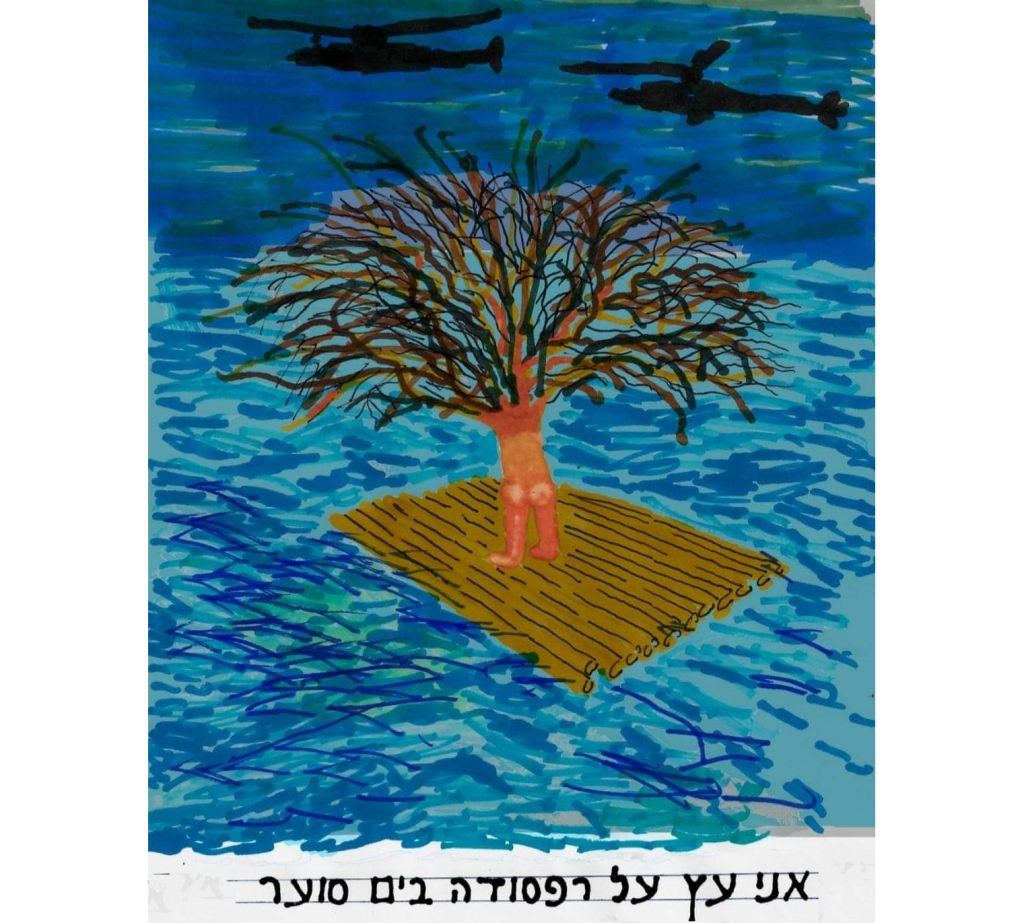
Most of this edition’s illustrations are by Engelmayer, which he calls “postcards”, and which reflect – we feel – a similar movement between hope and despair as we have felt and as is expressed in the various contributions.

Our deep gratitude to all the writers and contributors, to Ilan Kirschenbaum for placing so aptly this third digital edition, and to Zeev Engelmayer for allowing us to use his vivid postcards to connect our written words with Art.
Best wishes
Shely, Yermi and Eliat
The Editorial team
August 2024

Issue #4 – January 2026

Editorial

Letting go to letting be/ “when the home is empty, it doesn’t matter who is right” 

This edition started from a big emptiness – a depressed void – emotional, intellectual, social and political. We sent the call out in a time where splits seem to persevere over any attempt at connecting, healing or rehabilitating. Inside OFEK too there were exchanges characterised by the sound of the pencils being sharpened, and that old, familiar feeling of the need to be right, toppling the need to connect and make peace, was creeping up on us. The fourth edition of Kav OFEK stalled again then into silence. 

And then, yet again and despite it all, the editorial board continued. People started sending their promised contributions, including some where the context made us feel right to revive them, or to publish them again, as part of another frame.   The house started to refill, OFEK’s intellectual home began to shape up into what would become its fourth offspring. 

What can you expect to find in this edition? The publications are very different from each other, in form as well as in content. But they do have something in common. In different ways, they all deal with memory, death and dying; the study of the past in the present, including trauma and inter-generational trauma; and the painful yet hopeful inter-generational dynamics including succession and legacy:

We have a letter from Dr Mannie Sher, an OFEK father-figure, and  a TIHR elder, who is positively busy with legacy and who has recently published his personal memoir in the form of letters to his children and grandchildren (in-person book launch on 25 January 2026). On our request, he has written one such letter of wisdom to the OFEK offspring. We have a video interview of Prof Yigal Ginat, one of OFEK’s first fathers and a role-model to the profundity of the model of GR into all systems and organisational understanding and work. Speaking poignantly to Yermi Harel, Yigal takes us through a tour-de-force of a life-long activity in health and social care informed by the GR principles and thought, and including reflections on personal loss, grief and solitude. 

A thoughtful and thought-provoking piece entitled ‘The Fourth Injury’ by Nimrod Harel suggests that technology, with the fast developments in AI, constitute the fourth injury, should Freud was alive today to have defined it (Freud identified three core narcissistic injuries to the Human species as offered through scientific developments over the centuries: cosmological, biological and psychological). This article swims across a couple of generational rivers: human development and the examination of AI – so we include two responses to Nimrod Harel’s paper, one by Dr Kobi Tadmor and one by AI itself. The other generation river is the personal one: Nimrod is the son of Dr Yermi Harel, one of OFEK’s senior members as well as one of Kav OFEK’s editors. Here, the creative, fruitful, satisfying and proud-making aspects of succession and generational discourse. 

The contribution from Batel Friedman is a self-reflection on the experience of being an Other, in OFEK, and the pain and vulnerability that accompany. It is a striking article that highlights that “even” in OFEK, that is supposed to be an inclusive and pluralistic society, the experience of Otherness, and othering is very alive. Bat-El is a younger member of OFEK both by age and by years of membership so here, again, the dynamic of the generations appears. 

Gali Goren (et al) describes and reflects on two workshops conducted ‘under fire’ during 2025 with the primary task of digesting experiences of separation and endings, as a result of war. The work was commissioned by a charity called ‘for tomorrow’ that asked the team to run further workshops on this issue as well as on ‘moral injury’, a traumatising experience that occurs when a person is exposed to events that challenge their  values and principles, an injury that often occurs in war and conflict situations, where persons are at risk of dying.  

Yael Sharoni (et al) returns to reflect and draw lessons from a workshop alerting that corruption is not only a social phenomenon but a symptom to a deep and problematic social disease. The event took place eight years ago and feels like a premonition to what was to come. An eerie reminder of how we do not learn from our history, or past, and repeat or even expand our mistakes. 

A conversation between Gilad Ovadia, incoming and current Chair of OFEK, and Yoav Kirsch, outgoing Chair of OFEK and current Company CEO, explores the vulnerability and potential injury as one reflects on the transitions between different leadership roles. In a heart-to-heart, a man-to-man reflection shows the humanness in succession and transition. 

And finally, Orly Aflalo-Kamil rounds up the contributions to the book Sitting on a Suitcase by seven OFEK members  in a gentle and sensitively led conversation based on the book’s main hypothesis which is that Jewish identity – being an ongoing psychological experience shaped by a history of persecution, migration, and intergenerational trauma – has shaped the professional choices of the writers. 

We called for contributions in the spirit of Bion’s reverie, without memory or desire, and what has emerged is that and more, a rich tapestry of memories, re-membered experiences re-thought and re-integrated into a present which has freshness, hope and possibility in a context which could have hardly been any darker. 

We trust you will enjoy reading, watching and listening, and feel the weaving together warming you up on these cold winter nights.   


Orly, Shely, Yermi and Eliat

The Editorial Team
January 2026

Many Wars, One Peace – Many Lands, One Home

Table of Contents

Preface

On November 3rd, 2023, a suggestion was made at the monthly meeting of the Tavistock Community platform for the formation of a discussion group focused on Current Conflicts. The Tavistock community was established on the 70th anniversary of the Tavistock Institute of Human Relations and it’s a place for Alumni and Friends of the Institute to connect with others, exchange ideas, develop practice, expand learning and work together to create new partnership and work groups, all underpinned by Tavistock methodologies and within a framework hosted by the Institute. Our virtual weekly sessions commenced on November 9th, 2023, under the title ‘Many Wars, One Peace – Many Lands, One Home’. We conducted 13 weekly sessions with a core participation of five to seven members.

Throughout the process, the group expressed the need to broaden the discussion beyond the TC, leading us to organize a virtual open event. This event occurred on February 19th, 2024, with the primary objective being to share ideas and dreams directed towards ‘One Peace, One Home for All’.

This article presents the expectations, experiences, and understandings of six members of the core group/organizers. The writers were tasked with discussing the roles, structures, thoughts on micro and macro levels, shared writing, and the disjunction between expectation and reality. We welcome you, the readers of KAV OFEK to share you insights and reflections with us. 

The contributing writers are from South Africa, Italy, United States, Canada/Netherlands, Lithuania/UK, and Israel.


Asta Binkauskaite

The theme of “Many Wars, One Peace – Many Lands, One Home” is particularly significant to me since war erupted in Ukraine. Having been born in the Soviet Union and having witnessed Soviet tanks in Vilnius in 1991, the war brought back all the memories and it became clear that peace is transient.
During the recent group event I was doodling an image in my notebook, which – in hindsight – reminds me of Antoine de Saint-Exupéry’s drawing of an elephant swallowed by a snake. However, in my drawing it might be a monster instead of an elephant. So, this makes me think of ‘a monster in the room’ (take on the proverbial ‘elephant in the room’).
The doodle expresses my experience of the event. I had a feeling of something not happening, of fear, of feeling lost, of difficulty connecting, of awkwardness. In retrospect, there might have been a feeling of walking in a field of mines, or staying still, stilted, not catching life. At the time, I had in my mind a metaphor of mayonnaise not setting – when all the ingredients are there, but will not mix together in a satisfactory way.
I also had a thought that the vision of ‘One Peace… One Home’ is not achievable in this life; it might be a vision for the after-life. Thinking now of the event, I am wondering whether part of the issue was this aim of oneness, which froze or prevented the group from play. The idea of ‘One Home’ in my mind has connotations with Marxism and I associate it with the painful history of my native country.
The freeze at the beginning of the group was poignant; a comment that this silence echoed the silence in the world stayed with me.

Image: Asta Binkauskaitė, from Lithuania (Vilnius), based in UK (London), art psychotherapist and artist, completing a PhD in psychosocial studies on migration and trauma.

Alona Burshtine

The topic of “Many Wars, One Peace – Many Lands, One Home” drew me in from the TC posts in November 2023 and I joined the weekly discussion group. As an Israeli, I’ve experienced many wars and some periods of peace. Being the daughter of Holocaust survivals I understand firsthand that a land is not always synonymous with home.
Entering the small group, I was engulfed with tension, war happened outside my window, I sat in my “safe room” during the first meeting in case a siren sounded. Initially, I didn’t trust the members whom I hadn’t known previously. As the meetings progressed, the tension gradually dissipated and I felt safer within the small group.
Upon deciding to extend our discussions beyond the TC boundaries, the tension resurfaced. In my role as co-moderator for the large event, I relied on the trust built within our small group. Tension was shared by others and one of the members volunteered to take a role of “boundaries keeper” to prevent potential disruptions, such as a Zoom hijack.
At the public event on February 19th, 2024, we had 21 participants of various countries and backgrounds, including four Israelis. The atmosphere was very calm and empathic. Concrete conflicts were not directly addressed. The participants expressed a desire for common grounds, and a desire to avoid causing or experiencing harm.
As one of the moderators it felt good, peace amidst ongoing war. It felt like a success. Reflecting on the event with the small group a week later, I thought it might have been Oneness, that enabled an escape from uncomfortable differences and security in the feeling of belonging.
Since this was a one-time event, I don’t know what could have developed further. However, amidst the line between hope and despair, I find hope wherever people are gathered to communicate. The work in the small group and large group is making our world a better place.

Alona Burshtine, LL.B,LL.M., Groups Facilitator, member of OFEK, Israel

Flooris van der Walt

In a world often marred by conflict and division, the recent gathering themed “Many Wars, One Peace – Many Lands, One Home” stands as a beacon of hope and unity. As participants from various nationalities and religions convened in a spirit of mutual respect and understanding, it was evident that dialogue and cooperation can transcend barriers, fostering a sense of belonging and shared humanity.
The hallmark of this meeting was its commitment to fostering an environment of inclusivity and open dialogue. Through the utilization of the Tavistock method, every individual was allowed to express thoughts and perspectives freely, without fear of judgment or reprisal. This approach facilitated a rich exchange of ideas, allowing for a deeper appreciation of the diverse experiences and viewpoints present within the group.
One of the most striking aspects of the gathering was the genuine sense of empathy that permeated the discussions. Despite hailing from different corners of the globe and adhering to distinct faiths, participants demonstrated a remarkable capacity to empathize with one another’s struggles and aspirations. This shared empathy served as a powerful catalyst for building bridges across cultural and religious divides, fostering a sense of solidarity and interconnectedness.
Moreover, the meeting served as a poignant reminder of the universal desire for peace and harmony. Regardless of nationality or creed, it became apparent that all individuals present shared a common longing for a world free from the scourge of war and conflict. This collective aspiration served as a unifying force, transcending the superficial differences that often divide societies.
In essence, the gathering themed “Many Wars, One Peace – Many Lands, One Home” exemplified the transformative power of dialogue and mutual respect. By embracing diversity and fostering a culture of understanding, participants demonstrated that despite the many challenges that confront our world, there remains hope for a future characterized by unity and peace.

Flooris van der Walt, South African/Swiss, clinical psychologist, and psychodynamic therapist, facilitating workshops on “Building Courage to Face Change and Uncertainty” and “Healing Collective Trauma”.

Matthijs Kronemeijer

The February 19 event, of which I was a moderator, was the result of weekly online meetings of a small international group of people that over time morphed into a “preparation team”. Since October-November 2023 we met consistently and shared our experiences and views. Familiarity with the Tavistock approach varied widely among us.
I volunteered for the moderator role to make sure that the event would happen. I was aware of certain strains in the group that for reasons of my own (good or bad) I felt able to contain. In doing this role I prioritized the process of the group over my substantive interests.
During the preparation phase, the character of this “open” event shifted towards a more typical group relations event, bounded by strict timing and an agreed-upon script. The script proved time-consuming to produce. Different agendas in the team complicated things more. Matters of communication and role-division among ourselves suffered as a result.
During the days before the event I felt significant anxiety. I entered the event uncomfortable with my role as moderator, because I would necessarily (as I believed) be withholding my own content to hold the group. I was encouraged by Alona Burshtine as a co-moderator because of her personality and experience, but was keenly aware of our different identities: man/woman, secular/religious, non-Jewish/Jewish.
I had expected questions from participants about the nature and content of our previous discussions, but they did not come. A longer introduction might have produced a different effect. I also anticipated that one team member would contribute music but had not expected music of an experimental kind at the very start. I experienced it as unsettling and an attempt to assume leadership. I had a kintsugi video ready at hand as a “reframe”. This I then shared to bridge the gap between this member and his contribution and what else I believed was present in the system. As we went on my confidence increased.
I had expected that the other preparation team members would take a more active part in the conversation at the event than they did. I was somewhat frustrated that they did not, but did not consider calling them out, suspecting legitimate reasons for some. One team member tried to step up by sharing a formative personal experience, but it did not elicit a response. Halfway through I made my own identities explicit: to create clarity about our leadership, to bring in religion as a potential topic for discussion, to create some kind of equilibrium.
The silence during most of the event I interpret as a consequence of the unclarity of the roles and interconnections in the group; it was unclear who was in the “preparation team” (the term postdates the event) and who wasn’t, or who had invited whom. In addition to that, four Israeli and one Arab names stood out on the Zoom screen, which made the ongoing Israeli-Palestinian conflict a hidden presence in the room. These visible bits of information largely shaped where the discussion went.

Matthijs Kronemeijer is an independent Christian scholar. Parenting, writing, and volunteer projects take up most of his time. He lives in Toronto, Canada.

Joseph E Wise – A Peace Piece

My interest in this project stems from larger interests in Group Relations and the Tavistock. TC is an exciting potential space where GR-informed pursuits can flourish, across international boundaries. I am personally invested in the TC, having been in a Cultivator role.
In November 2023 there were discussions in TC after the Hamas attacks, and I was interested in continuing the dialogue. I offered my Zoom as a way to enhance the dialogue. Our group formed under the banner “Many Wars, One Peace – Many Lands, One Home” and we had our first weekly meeting on November 9th, 2023. We talked about the Israeli-Hamas war, connecting the sentiments to many historical conflicts. A special moment occurred on December 21st, 2023, when many, from our TC group, participated in an OFEK large group, giving us a feel of the vitality of large groups. Our TC group began planning an event of our own, slated for February 19th.
As we began planning for our “Many Wars, One Peace – Many Lands, One Home” event, it was co-occurring with American Presidents’ Day. I thought it was best to request Tavistock or another member provide the Zoom link for our event. Interestingly, the Tavistock Institute declined to provide Zoom resources for our event. In the lead up, several posted to various listservs to advertise. I posted to the “G-P list” (a group-psychotherapy email moderated by Dr Weinberg, hosted on APA servers). In inviting others, this was the first time TC made contact with groups outside of TC.
In preparations leading to the February 19th event, I coordinated with our Zoom Host Bob Hsiung. I would become Co-Host with him, and focus on Managing the Boundary. Given the controversy of this topic, I was prepared to remove disruptive members—I would be providing security. During the event, I was vigilant about the boundary and the possibility of removing a Zoom-bomber. This left me in a listening mode, and I did not contribute to the verbal discussions much. I was on guard/sentry (which was my brief comment at the event, linking to Oct 7th, by saying “what happens when the sentry falls asleep?”). As it would turn out, one attendee inadvertently ‘shared screen’. I jumped into action, calling out that person and quickly shutting that down on Zoom.
In terms of review and where we go from here, I feel like the “Many Wars, One Peace – Many Lands, One Home” has been a success, both in the small group meetings and the larger event. Moving forward, it would be exciting to build on this by hosting a Group Relation Conference (online, I suppose) with this title. I could imagine our group being the staff.

Joseph E Wise, MD is a child, adolescent, adult psychiatrist and psychoanalyst in private practice in Brooklyn, NY, USA. He is also a Certified Group Psychotherapist (CGP), and has consulted at GRCs. joseph.wise.md@gmail.com

Alessandro Dolci (Rome, Italy)

One of the most remarkable aspects of the initiative, from the point of view of us Tavistock Community, was the openness of the event to ‘outside’ participants. The invitation was extended beyond members of our community, and even beyond people belonging to the vast territory of ‘Group Relations’. A perfect example of what, in Tavistock jargon, could be defined ‘crossing the boundaries’. As the result, no one of us really knew what kind of people would join the Zoom session and (more importantly) what kind of unexpected ‘chemical reaction’ could result from such heterogeneous assembly of different valences. This, given the theme of the meeting, raised a quite remarkable amount of anxiety.
The surprise effect was magnified by the fact that, after the opening of the moderators, the first intervention was the recitation of an original poem titled ‘Sacri-ficium’, where my voice was unexpectedly surrounded by any kind of electronic sound effects created in real time. The poem and the performance are dedicated, as a gift, to Yusuf Kaplan, spiritual adviser and member of The Tavistock Community, who helped me in the journey of private life. Yusuf inspired the poem and sound performance, and conceived also the phrase ‘Many wars, One Peace’ from where the initiative started. During the event, this personal dedication was extended to all the people suffering from war and oppression. I wonder how this contributed to set the ‘tempo’ of the meeting and maybe the answer is embedded in what is written by the dear fellows of our small group. Working with them was a unique, enriching experience and I am so grateful for this!
What I can say is that if outside the ‘soundtrack’ was the one of violence and war, inside the ‘sound’ was the one of Peace. It tells much about the foundational concept of exile, which is always somewhere else in space and time, and always outside. There is no exile in the here and now. There is no exile inside.
The outside is the Other. So, to live out of exile, to fully live in the here and now we are called to look our Other in the eyes. Cain, the Criminal, the Doppelgänger, transcends space and time. This main protagonist of our History, in the form of the Tyrant or the Terrorist, assumes now the shape of the Great Guardian.
Good news, because it means this is the Last Step. But to enter inside, we need to overcome our Fear of Victory and take the Third Way between the two pillars of the Paranoid-Schizoid Position of eternal war and the Depressive Position of hopeless surrender to the Labor of Sisyphus that is the evil.
The Third Way is the way of LOVE, where the outside and the inside become One. Let’s go!

Alessandro Dolci, composer, pianist, creative, member of The Tavistock Community. Rome, Italy

Concluding

In summary, the decision to engage in shared writing for KAV OFEK was driven by the aim to capture a wide array of perspectives on a singular event. While the process itself was largely positive and tranquil, it also shed light on certain internal issues within our group. Matters such as boundaries, entitlement, and conflicts, which had lain dormant during the event, suddenly surfaced during the writing process. Interestingly, it appeared that the setting of our small group provided fertile ground for these conflicts to emerge.

Our small writing group with the support of the editing committee, effectively addressed and contained these conflicts. As a result, we are pleased to present the final outcome to you today. We encourage our readers to actively engage with the article and to share their thoughts and comments with us.

Leave a Reply

Your email address will not be published. Required fields are marked *